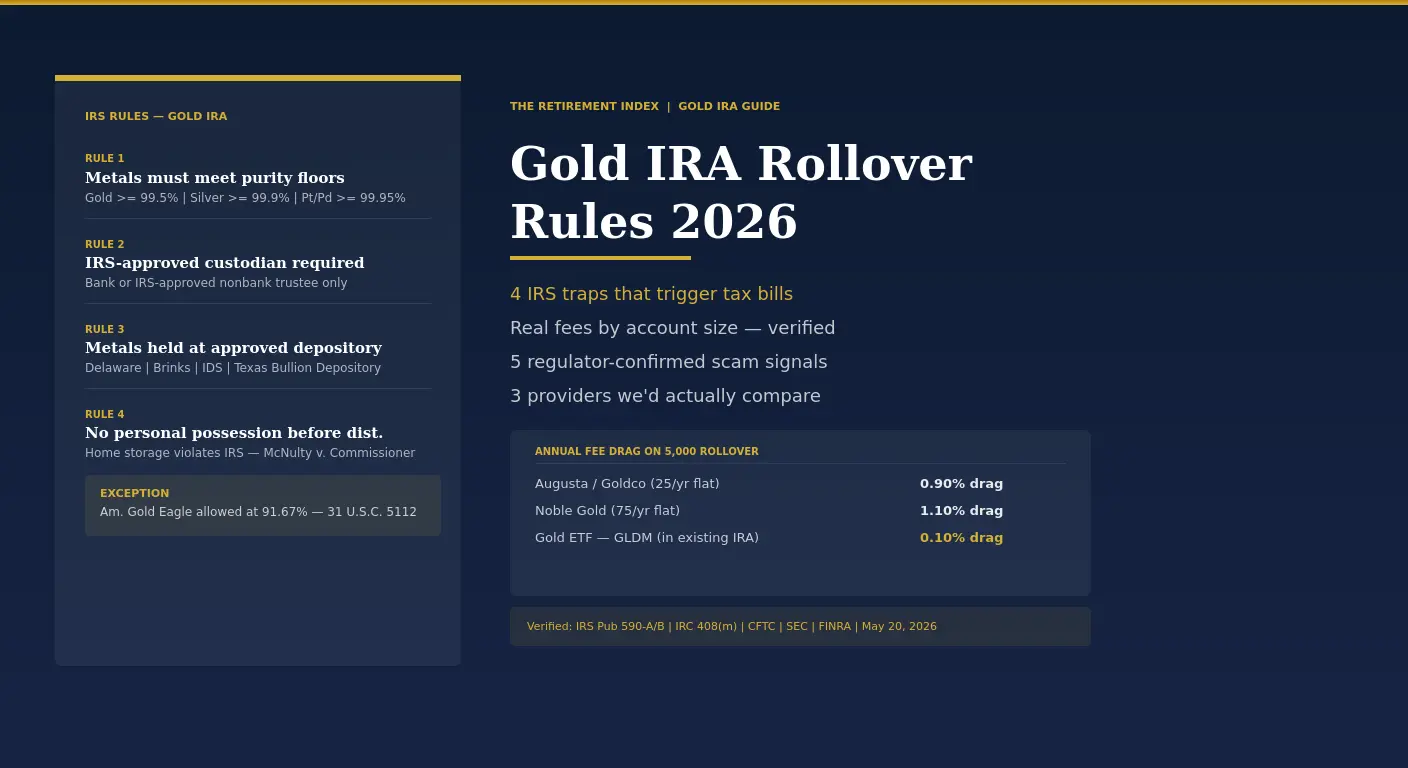
60-second verdict
Is a Gold IRA Rollover Right for You?
A gold IRA rollover moves eligible retirement money — usually from an old 401(k), 403(b), TSP, or IRA — into a self-directed IRA that holds IRS-allowed physical gold, silver, platinum, or palladium. Done as a direct rollover or trustee-to-trustee transfer, it can avoid current taxes and early-withdrawal penalties. Done wrong — through a 60-day rollover that misses the deadline, with the wrong coins, or with metals stored at home — it can produce a five-figure IRS tax bill.
| Your situation | Likely fit | Why |
|---|---|---|
| $100K+ saved, age 50+, want a limited metals allocation | ✅ Worth comparing | Flat fees become a smaller share; allocation in line with diversification thinking |
| Old 401(k), 403(b), or TSP from a former employer | ✅ Easiest rollover | Direct rollover available; no in-service distribution rules to fight |
| Existing Traditional or Roth IRA | ✅ Easiest transfer | Trustee-to-trustee transfer dodges most IRS traps |
| Under $25,000 to allocate to gold | ⚠️ Probably wrong vehicle | Flat fees eat 0.9–6% per year — a gold ETF is far cheaper |
| Anyone pitching a 100% gold rollover | 🚨 Walk away | CFTC, FINRA, and NASAA have jointly warned against this sales tactic |
| Anyone pushing 'premium' or 'collectible' coins | 🚨 Walk away | Exact bait-and-switch the SEC charged Red Rock Secured with |
| Under 59½ considering an indirect 60-day rollover | ⚠️ High risk | 20% mandatory withholding + 10% additional tax if deadline slips |
~$225–$355 admin + storage, plus bullion spread (ask in writing)
CFTC alleged 100%–300%+ markups in the Metals.com/TMTE case
2–4 weeks from paperwork to funded account
Plain English
What a Gold IRA Rollover Actually Is
A gold IRA rollover is the act of moving retirement money out of one tax-advantaged account and into a self-directed IRAset up to hold physical precious metals. The IRS doesn’t have a special “Gold IRA” account type — it’s a regular IRA with a custodian that allows physical metals, governed by IRC Section 408 plus the precious-metals carve-out in Section 408(m)(3).
Three things happen during a rollover:
- 1.You open a self-directed IRA with a custodian that handles physical metals — Equity Trust, STRATA Trust, Kingdom Trust, and GoldStar Trust are the four most common.
- 2.You move funds in from your 401(k), 403(b), TSP, or another IRA — directly, custodian to custodian.
- 3.The IRA buys metals through a dealer, and those metals ship straight to an IRS-approved depository. You never touch them.
What it is not
- Not a way to keep gold bars at home
- Not a new annual IRA contribution — rollovers don’t count against the 2026 IRA contribution limit of $7,500 ($8,600 if age 50+)
- Not a guarantee against market losses — gold has its own drawdowns, with fees layered on top
- Not automatically tax-free in every case — a qualifying direct rollover is generally tax-deferred, while Roth conversions and other taxable distributions have different treatment
A “gold IRA,” a “precious metals IRA,” and a “self-directed IRA holding bullion” are all the same animal in three different marketing outfits.
Tax treatment
Can You Roll Over a 401(k) Into a Gold IRA Without Paying Taxes?
Yes — if you do a direct rollover or trustee-to-trustee transfer. Both methods move money from one qualified retirement account to another without the funds ever touching your bank account. The mandatory 20% withholding from employer plans does not apply.
You can still hit a tax bill if:
- 1.You take the money personally (indirect rollover) and miss the 60-day deadline. Miss it and the distribution becomes taxable income. A 10% additional tax applies if you’re under 59½ unless an exception applies.
- 2.An employer plan withholds 20%and you don’t replace that 20% out of pocket when completing the rollover. The withheld portion that isn’t redeposited is taxable.
- 3.You roll over your RMD. Required Minimum Distributions are not eligible rollover distributions. Period.
- 4.You roll over an ineligible distribution — a return-of-contribution, a hardship withdrawal, or a few other categories.
- 5.You buy non-qualifying metals or take personal possession.Either one can trigger taxable distribution treatment for the amount involved, plus the additional 10% tax if you’re under 59½.
The single most important instruction:
Prefer asking the plan administrator to make the check payable to your new IRA custodian “for the benefit of (FBO) [your name]”. If an eligible distribution is instead paid to you, an indirect rollover may still be completed within 60 days, but employer-plan withholding applies and you must replace the withheld amount to roll over the full distribution.
IRS distinction
Gold IRA Transfer vs. Rollover: Why the Difference Matters
People use “rollover” and “transfer” interchangeably. The IRS doesn’t. The distinction can save you from one of the most common — and expensive — mistakes in this whole process.
| Method | Used for | Funds touch you? | Withholding? | 60-day clock? | Once-per-12-months? |
|---|---|---|---|---|---|
| Direct rollover | 401(k), 403(b), governmental 457(b), TSP → IRA | No | No | No | No |
| Trustee-to-trustee transfer | IRA → IRA | No | No | No | No (key exception) |
| Indirect (60-day) rollover | Either, but you receive the funds | Yes | Yes (20% from employer plans) | Yes | Yes (IRA-to-IRA only) |
The once-per-12-months rule — codified in IRC §408(d)(3)(B) — is where most people get burned. If you do an indirect IRA-to-IRA rollover, you can’t do another for 12 months from any of your IRAs (Traditional, Roth, SEP, or SIMPLE combined). Trustee-to-trustee transfers are unlimited.
Practical takeaway
Moving between two IRAs? Ask for a transfer. Moving from an employer plan? Ask for a direct rollover. Both keep the funds out of your hands and both dodge the 60-day clock entirely.
Account-type matrix
Are You Eligible? Route Matrix by Account Type
Eligibility depends entirely on what kind of account you’re rolling from— and whether you’re still working for the employer that sponsors it.
| Starting account | Cleanest route | Eligible? | Main IRS trap | Best next move |
|---|---|---|---|---|
| Old 401(k) (former employer) | Direct rollover | Almost always | 20% withholding if paid to you personally | Ask plan admin for direct rollover paperwork, FBO new IRA custodian |
| Current 401(k) (still employed) | In-service rollover if plan allows | Maybe — depends on plan terms | Many plans don't permit in-service rollovers before age 59½ | Call the plan administrator before opening any gold IRA |
| 403(b), governmental 457(b), or TSP | Direct rollover | Usually | Government plans have specific paperwork | Get distribution rules from your plan admin first |
| Traditional IRA | Trustee-to-trustee transfer | Always | One-rollover-per-year rule on indirect IRA-to-IRA | Request custodian-to-custodian transfer; preserve Traditional tax character |
| Roth IRA | Roth-to-Roth trustee transfer | Always | Moving between Roth and Traditional changes tax character | Make sure paperwork preserves Roth character |
| SEP IRA | Trustee-to-trustee transfer | Usually | Standard IRA rollover rules apply | Direct transfer; verify business plan details if still contributing |
| SIMPLE IRA | Transfer — only after two-year rule | Conditional | Distribution during first 2 years → 25% additional tax if under 59½ | Verify SIMPLE IRA start date before doing anything |
| Inherited IRA (non-spouse) | Special rules apply | Depends | SECURE Act 10-year distribution rule + rollover restrictions | Talk to a CPA before moving these funds |
| RMD dollars (age 73+) | Do not roll over | No | RMDs are not eligible rollover distributions | Take the RMD as cash first, then evaluate remaining balance |
Two situations that get botched constantly
The SIMPLE IRA two-year trap
If your SIMPLE IRA was opened less than two years ago and you take a distribution to move it to a non-SIMPLE IRA, the IRS treats it as a taxable distribution. If you’re under 59½ and no exception applies, the usual 10% additional tax jumps to 25%. Confirm the original SIMPLE IRA effective date before anyone moves a dollar.
The RMD trap
RMDs generally begin for the year you turn 73. The amount you’re required to take is not an eligible rollover distribution. If an RMD is improperly rolled into an IRA, it can become an excess contribution. Excess IRA contributions are taxed at 6% per year for each year the excess remains in the IRA.
Non-negotiable
The 4 IRS Rules Every Gold IRA Has to Follow
If you remember nothing else from this page, remember these four rules. Breaking them can create taxable distribution treatment, a 10% additional tax if you’re under 59½, and in some structures broader IRA or prohibited-transaction problems.
The metals must meet IRS purity standards
Under IRC Section 408(m)(3), the IRS only allows specific precious metals inside an IRA:
| Metal | Minimum fineness | Common eligible products |
|---|---|---|
| Gold | 99.5% (.995) | Canadian Gold Maple Leaf, American Gold Buffalo, Austrian Philharmonic, LBMA-approved bars |
| Silver | 99.9% (.999) | American Silver Eagle, Canadian Silver Maple Leaf, qualifying bars |
| Platinum | 99.95% (.9995) | American Platinum Eagle, qualifying bars |
| Palladium | 99.95% (.9995) | Qualifying bars from approved refiners |
American Gold Eagle exception:The American Gold Eagle is only 91.67% pure — but it’s IRA-eligible because Congress specifically authorized it under 31 U.S.C. §5112. Krugerrands, most pre-1933 U.S. coins, “proof” coins, Most collectible coins do not qualify, but specific coins and qualifying bullion are exceptions under IRC Section 408(m)(3). Proof finish alone does not determine IRA eligibility. Have the custodian verify the exact product; eligibility does not make a high-premium coin a good purchase.
The IRA must use an approved custodian
Brokerage availability varies. Fidelity and other brokerages may offer some precious-metals IRA services, while physical-bullion custody may require a self-directed IRA custodian — a bank, federally insured credit union, or IRS-approved nonbank trustee set up to hold alternative assets. Confirm the exact metals, custody, and depository options before opening the account. The largest is Equity Trust Company, which reports $72 billion in retirement assets across roughly 359,000 accounts (as of 03/31/2026). STRATA Trust, Kingdom Trust, GoldStar Trust, and The Entrust Group are the other common names.
Important distinction: The custodian is the legal IRA administrator. The dealer (the gold IRA company) sells you the metals. The depositorystores the metals. Three separate entities. The dealer earns compensation through the metal spread — that’s why they have a financial reason to sell you more metal.
Metals must be held by a bank or IRS-approved nonbank trustee
You cannot store IRA-owned gold at home. The IRS bullion exception in Section 408(m)(3) requires physical possession by a bank or IRS-approved nonbank trustee. Personal possession can convert the holding into a taxable distribution. The Tax Court case McNulty v. Commissioner (T.C. 2021)rejected personal possession of IRA-owned coins through an LLC structure marketed as a “Home Storage IRA.”
Major approved depositories:
- Delaware Depository Service Company (Wilmington, DE) — up to $1 billion all-risk insurance through Lloyd's of London
- Brink's Global Services USA (Los Angeles, New York, Salt Lake City)
- International Depository Services (IDS) Group (Delaware and Texas)
- Texas Bullion Depository (Leander, TX) — only state-owned precious metals vault in the U.S.
- CNT Depository (Bridgewater, MA) — COMEX-approved
You cannot personally possess the metals before distribution
The metals stay in the custodian/depository structure until you take a formal distribution. At distribution you have two choices: a cash distribution (metals are sold, proceeds go into IRA cash, you withdraw cash — standard IRA tax treatment), or an in-kind distribution (metals are shipped to you, fair market value at distribution is the taxable amount).
“Home Storage Gold IRA” and “Checkbook IRA” pitches
These use LLC structures to try to work around Rule 4. McNulty v. Commissioner rejected that exact approach. If a company tells you home storage is possible, they are either uninformed or willing to put your retirement at risk for a commission. Either disqualifies them.
Eligible products
Which Coins and Bars Are Actually Allowed in a Gold IRA?
IRA-eligible
Gold
- American Gold Eagle (statutory exception, all weights)
- American Gold Buffalo (.9999)
- Canadian Gold Maple Leaf (.9999)
- Austrian Gold Philharmonic (.9999)
- Australian Gold Kangaroo (.9999)
- Gold bars from LBMA/COMEX/NYMEX-approved refiners, .995+
Silver
- American Silver Eagle (statutory exception)
- Canadian Silver Maple Leaf (.9999)
- Austrian Silver Philharmonic (.999)
- Silver bars from approved refiners, .999+
Platinum & Palladium
- American Platinum Eagle (.9995)
- Canadian Platinum Maple Leaf (.9995)
- Platinum and palladium bars from approved refiners, .9995+
Refuse these
- ✗Pre-1933 U.S. gold coins (most don't meet the purity floor)
- ✗South African Krugerrands (91.67%, not in the statutory exception)
- ✗Proof coins that fail the applicable purity, issuer, or other IRA-eligibility requirements
- ✗"Numismatic," "rare," "limited edition," "first strike," or "premium" coins when they are not eligible under the applicable rules
- ✗"Exclusive" coins your dealer controls the market for (the SEC's exact charge against Red Rock Secured)
- ✗Any coin where the dealer can't tell you the spot price vs. your price breakdown in writing
Fee math
The Real Cost of a Gold IRA: Fee Drag by Account Size
A gold IRA from a legitimate company isn’t expensive in raw dollars — the providers we verified run roughly $225–$355 per year in admin and storage fees combined. The problem is those are flatfees. On a small account, $225 a year is a brutal drag. On a large account, it’s a rounding error.
We ran the math at six common account sizes using $225/year as the benchmark — this matches Augusta’s public ongoing fee example and Goldco’s published cost guidance. Birch publishes $235 ongoing; Noble publishes $275 — so $225 is the lower end of verified examples.
| Gold IRA balance | Annual flat fee | Fee as % of balance | Practical reality |
|---|---|---|---|
| $5,000 | $225 | 4.50% | Almost never worth it — a gold ETF is dramatically cheaper |
| $10,000 | $225 | 2.25% | Still high; will eat real returns over 10 years |
| $25,000 | $225 | 0.90% | Crossover point — starts to become reasonable |
| $50,000 | $225 | 0.45% | Comparable to many actively managed funds |
| $100,000 | $225 | 0.225% | Fees become a non-issue; spreads and allocation matter more |
| $250,000 | $225 | 0.09% | Essentially free, in percentage terms |
The honest part most pages won’t say
Before you call anyone, run this math
A $50,000 position in IAU (0.25% expense ratio) inside a Fidelity rollover IRA costs roughly $125/year, with no setup fee, no storage fee, and no dealer markup. GLDM (0.10%) at the same balance costs about $50/year. The same $50,000 in a physical Gold IRA at Goldco with non-segregated storage costs $225/year in account fees, plus a one-time dealer markup of 5%–10% on the metal, plus an exit spread when you eventually sell.
If gold price exposure is what you actually want, an ETF wins on cost. If physical custodyof the metal at a vault is what you want — for hedge-against-the-system reasons or in-kind distribution flexibility — the physical IRA is the right tool, and the costs above are what you pay for it. We earn nothing if you buy a gold ETF instead. We’re telling you anyway.
If you do want physical metal in a tax-advantaged account, and your rollover is at least $25,000, the math starts making sense. Keep reading. See our full rollover company comparison →
Side by side
Gold IRA vs Gold ETF vs Physical Gold: Which Fits Your Situation?
| Factor | Gold IRA (physical bullion) | Gold ETF (in existing IRA) | Physical gold (taxable) |
|---|---|---|---|
| Tax treatment | Tax-deferred or tax-free (Roth) | Tax-deferred or tax-free (Roth) | Up to 28% collectibles rate at sale |
| Annual cost | $225+ admin/storage + spread | 0.10–0.40% expense ratio | Storage + insurance you pay |
| Physical metal ownership? | Yes — IRA-owned, held through custodian/depository | No — exchange-traded exposure | Yes — you possess it |
| Liquidity | 1–2 weeks to sell | Same-day | Depends on local dealer |
| Storage rules | Required through bank or approved trustee | None | Your responsibility |
| Best for | $25K+, want physical inside tax shelter | Any size, want gold exposure cheaply | Personal possession outside retirement |
The right choice depends on whether you specifically value physicalownership. For some retirees that matters enormously. For others, gold price exposure is gold price exposure and the cheapest wrapper wins. Anyone telling you there’s a universally right answer — particularly a sales rep at a gold IRA company — has a financial incentive to push you toward the more expensive wrapper.
Verified enforcement patterns
The 5 Red Flags That Mean You’re Being Sold a Scam
These aren’t theoretical. Every one of these patterns comes from actual CFTC, FINRA, NASAA, or SEC enforcement actions. If any of them shows up in your sales conversation, hang up.
"You should roll over 100% of your retirement savings into gold."
A 100% gold rollover is not a diversified retirement allocation, and the CFTC, FINRA, and NASAA have jointly warned retirees about salespeople pressuring them to move retirement savings into precious metals using exactly this kind of language. If they push 100%, they’re not advising you. They’re selling you.
"We're offering you special 'premium' or 'collectible' coins instead of standard bullion."
This is the exact charge the SEC filed in its case against Red Rock Secured LLC. According to the SEC, Red Rock told retirement investors they would pay 1%–5% markups — while actually charging up to 130%. The final judgment ordered more than $76.4 million in disgorgement, interest, and penalties. The same playbook drove the TMTE/Metals.com case, where the CFTC and 30 state AGs charged $185 million solicited from ~1,600 mostly elderly investors at markups from 100% to 300%+.
"This offer expires today" or "We need to fund your account this week."
Real gold IRA rollovers take 2–4 weeks regardless. There is no legitimate financial reason to rush the funding. High-pressure timing — “lock in today’s price,” “the next price increase is coming Monday” — is one of the most consistent indicators across CFTC enforcement actions in this space. Take the weekend. The price of gold is not going to make or break your retirement based on which Tuesday you fund the account.
"You can store the gold at home — it's called a Home Storage Gold IRA."
The IRS bullion exception requires physical possession by a bank or IRS-approved nonbank trustee. Personal possession can trigger distribution treatment. McNulty v. Commissionerruled definitively against personal-possession structures. “Home Storage IRA” pitches still circulate using LLC structures. The IRS FAQ is clear: metals must be in the physical possession of a bank or IRS-approved nonbank trustee — including through indirect LLC acquisition.
The 'advisor' isn't a registered fiduciary.
Most gold IRA sales reps are salespeople, not fee-only fiduciary investment advisers. Verify in 60 seconds:
- FINRA BrokerCheck — search the rep’s name
- SEC Investment Adviser Public Disclosure — verify any “registered investment advisor” claim
- Your state securities regulator — via NASAA.org
Before you fund anything
The 15-Question Written Quote Script
Print this. Bring it to the call. Ask for written answers — email is fine — before you fund the account. A company worth considering should answer these in writing. If they refuse to put fees, spread, storage, and buyback terms in writing, stop.
Custodian and storage
- Who is the IRA custodian, and are they a bank or IRS-approved nonbank trustee?
- Who is the depository, and how does the bank-or-approved-trustee requirement apply to my specific account?
- Is storage segregated or non-segregated, and what does it cost in each tier?
- How is the metal insured, and by whom?
Fees
- What is the one-time account setup fee?
- What is the annual administration fee?
- What is the annual storage and insurance fee?
- Are fees flat or asset-based?
- Are any fees waived in year one, and what's the threshold?
The metals themselves
- What specific coins or bars are you recommending — standard bullion or 'premium' products?
- What is today's spot price for each metal?
- What is my price per ounce over spot for each product you're recommending?
- What is your current buyback spread — how much less per ounce would you pay me to sell back today?
Promotional offers
- If you're offering 'free silver' or any bonus, is that bonus built into the metal price — or is it actually free?
- What happens if I change my mind after I sign paperwork but before I fund the account?
If you get pushback on any of them — particularly questions 10 through 14 — that’s the answer to whether you should proceed.
Verified fee comparison
Top Gold IRA Companies in 2026: Verified Fee Comparison
Our methodology:We required each provider to clear six gates: (1) verified public minimum, (2) published fee transparency, (3) custodian and depository relationships disclosed, (4) buyback policy stated, (5) regulator/lawsuit red-flag check (FINRA, SEC, CFTC, BBB), and (6) willingness to answer the 15-question script in writing. Figures verified against company public pages on May 20, 2026. Where not published, we mark it “not fully published — written quote required.”
| Provider | Min | Setup | Year-1 total (example) | Year-2+ annual (example) | Custodian | Spread published? |
|---|---|---|---|---|---|---|
| Augusta Precious Metals | $50,000 | $50 | $275 example | $225 example | Equity Trust | 5% buyback (public); per-product requires written quote |
| American Hartford Gold | $10,000 (verified) | $0 | Not fully published — written quote required | Not fully published — written quote required | Equity Trust, Entrust Group | No |
| Goldco | $25,000 | ~$50 | ~$275–$325 | ~$225 ongoing | Equity Trust | No |
| Birch Gold Group | $5,000 recommended | $50 + $30 wire | $315 first year | $235 ($110 storage + $125 mgmt) | Multiple | No |
| Noble Gold Investments | Verify with company | $80 | $355 ($80 + $275 flat) | $275 flat (incl. $125 custodial + $150 seg. storage) | Equity Trust | No |
Augusta Precious Metals
Augusta is the only major gold IRA company we found that publishes a complete fee sheet on its public site, requires every account to attend a 1-on-1 educational web conference before purchase, and lays out its 5% buyback spread directly in the public transaction agreement. The minimum is high — widely reported at $50,000 — but the trade is straightforward: you get the most transparent process we’ve documented in the industry.
Verified from public materials
- $50 one-time custodian application
- $125/year custodian admin
- $100/year sample storage (Delaware Depository)
- $275 first-year example; $225 recurring annual example
- 5% buyback spread in public transaction agreement
- Augusta has historically never declined a buyback
- Custodian: Equity Trust · Depository: Delaware
Best for: Pre-retirees and retirees with $50K+ who want the most transparent process and the fewest follow-up sales calls.
Request Augusta’s Free 2026 Information Kit →American Hartford Gold
If you have less than Augusta’s threshold, American Hartford Gold is the most accessible major option, with the lowest verified minimum of the three at $10,000. Their public FAQ confirms the $10,000 minimum order size.
Verified from public materials
- $10,000 minimum (verified on AHG FAQ page)
- Multiple custodian options (Equity Trust, Entrust Group)
- Delaware, Brink's, and IDS depository options
- A+ BBB rating
Best for: Anyone with $10K–$25K who wants the lowest barrier to entry — provided they demand the full written fee quote before signing.
Request American Hartford Gold’s Information Kit →Goldco
Goldco has been in the gold IRA business since 2006 — longer than Augusta or American Hartford Gold — and has built its model specifically around 401(k) rollover execution. They assign a dedicated specialist to your rollover from paperwork through funding.
Verified from public materials
- $25,000 minimum
- ~$225 annual ongoing fees (Goldco published guidance)
- ~$275–$325 first-year total (per Goldco examples)
- Custodian: Equity Trust · Depository: Delaware or Brink's
- Highest-buyback-price guarantee; no liquidation fee
Best for: Anyone specifically rolling a 401(k) or 403(b) of at least $25K who wants a guided process with a dedicated specialist and a documented buyback policy.
Request Goldco’s Free Information Kit →Honest mention: Birch Gold Group and Noble Gold Investments
Both are legitimate operators with detailed public fee disclosures. Birch’s IRA page lists $50 setup, $30 wire, $110 storage/insurance, $125 management, and $235 annual, with first-year fees potentially covered on transfers over $50,000. Noble’s published flat structure is $80 setup followed by $275 annual including $125 custodial and $150 secure segregated storage. We didn’t feature them as primary picks because — on the same methodology — Augusta gives the cleanest published fee sheet at the $50K tier, AHG gives the lowest verified minimum at the $10K tier, and Goldco gives the strongest dedicated 401(k) rollover support at the $25K tier. If Birch’s lowest published minimum or Noble’s Texas storage specifically suits your situation, they’re real choices. See all 8 providers in our full comparison →
Process timeline
How Long Does a Gold IRA Rollover Take?
A clean direct rollover usually takes 2 to 4 weeks from start to funded account — though the exact timing depends heavily on your old plan administrator, not the Gold IRA company you choose. For a stage-by-stage breakdown with delay red flags and call scripts, see our full Gold IRA rollover timeline and delay checklist. Here’s a realistic overview:
Days 1–3
Open the self-directed IRA. Application typically takes 10–20 minutes online or by phone.
Days 3–7
Submit rollover paperwork to your current 401(k) or IRA administrator. Provide your new IRA's account number and the custodian's mailing address for the FBO check.
Days 7–21
Current administrator processes the request. This is the most variable step — some take a few days, others take three weeks. Government and union plans (TSP, large 403(b) systems) tend to be slowest.
Days 21–28
Funds arrive at your new IRA. Cash position is confirmed.
Days 28+
You select metals, the dealer locks in the price, and the metals ship from dealer to depository. Allow 5–10 business days for confirmation at the vault.
Do not buy metals before the funds clear.
Some salespeople encourage you to “lock in today’s price” before the rollover is complete. This creates obligation without ability to deliver — a high-pressure situation that often ends with the customer feeling rushed or trapped. Wait for confirmed funds, then place the order.
After the rollover
What Happens After Your Gold IRA Is Funded
Annual statements
Your custodian provides quarterly or annual statements showing your holdings. Investor.gov specifically warns that self-directed IRA statements may reflect values that haven't been independently verified — cross-check against the depository's records when you can.
Ongoing fees
Annual admin and storage fees are billed on the account anniversary. Watch for them on your custodian statement, and watch for any year-2 fee jumps if your year-1 fees were waived.
RMDs at age 73
For Traditional gold IRAs, RMDs generally begin at age 73 under SECURE Act 2.0. Roth gold IRAs aren't subject to RMDs during the owner's lifetime. You can satisfy an RMD with either a cash distribution or an in-kind physical delivery — both are taxable events for Traditional IRAs.
Selling
When you want to liquidate — for an RMD, a planned distribution, or because you’ve changed your mind about the allocation — your dealer’s buyback policy kicks in. You sell back at the spread they disclosed, and the proceeds go into your IRA cash position. From there you can take a distribution (taxed at ordinary income rates for a Traditional IRA, tax-free for a qualified Roth) or reinvest into other IRA-permissible assets.
18-point checklist
The Complete Pre-Rollover Checklist
Before you sign anything, run through this list. If you can check every box, you’re in a position to compare written quotes or bring the file to a fiduciary advisor. If any item is unchecked, that’s a stop-here moment.
Account verification
- You know the exact account type you're rolling from
- If it's a SIMPLE IRA, you've confirmed it was opened more than 2 years ago
- If you're age 73+, you've calculated this year's RMD and set it aside
- If still employed rolling from a current 401(k), you've confirmed in-service rollovers are allowed
Rollover method
- You've chosen a direct rollover or trustee-to-trustee transfer (not an indirect 60-day rollover)
- The rollover check will be payable to the new IRA custodian FBO [your name], not to you personally
Provider verification
- You've checked the company on BBB and BCA — live pages, today
- You've checked any individual rep on FINRA BrokerCheck
- You've reviewed the company's fee schedule in writing
- You have the bullion spread quoted in writing for the specific products being recommended
- You have the buyback spread quoted in writing
Allocation
- If you choose gold, you're keeping it as a limited diversification sleeve — not your entire retirement account
- You've considered (and either chosen or ruled out) a low-cost gold ETF as an alternative
- If your rollover is under $25K, you've confirmed you understand the fee drag
Red flag check
- No one has pressured you with a deadline
- No one has recommended 'premium,' 'rare,' or 'collectible' coins
- No one has mentioned 'home storage'
- No one has told you to roll over 100% of your savings
If all 18 boxes are checked, you’re ready to compare written quotes — or to bring the file to a fiduciary advisor for a final review before funding.
Methodology and verification log
What We Verified (and What Still Needs a Second Look)
Verified May 20, 2026
- ✓IRS rollover rules: 60-day deadline, one-rollover-per-year, RMD ineligibility, SIMPLE IRA two-year rule (IRS Pub 590-A, 590-B, IRC §408(d)(3))
- ✓IRS collectibles and bullion exception under IRC §408(m)(3)
- ✓American Gold Eagle statutory exception — 31 U.S.C. §5112
- ✓2026 IRA contribution limits ($7,500; $8,600 if age 50+) per IRS guidance
- ✓Augusta fee schedule: $275 first-year example, $225 ongoing, 5% buyback spread
- ✓Goldco: $25,000 minimum, ~$225 annual ongoing
- ✓American Hartford Gold: $10,000 minimum per AHG FAQ
- ✓Birch Gold: $50 setup, $30 wire, $110 storage, $125 management, $235 annual
- ✓Noble Gold: $80 setup, $275 annual flat (including $125 custodial + $150 seg. storage)
- ✓Equity Trust: $72 billion in assets, ~359,000 accounts (03/31/2026)
- ✓CFTC PR 8881-24 (joint warning with FINRA and NASAA on precious metals fraud)
- ✓SEC v. Red Rock Secured LLC (LR-25996) — $76.4M judgment, 130% markups
- ✓CFTC + 30-state-AG v. TMTE/Metals.com ($185M, ~1,600 investors, 100–300%+ markups)
- ✓McNulty v. Commissioner (T.C. 2021) — personal possession rejection
- ✓FDIC deposit insurance: $250,000 per depositor, per insured bank, per ownership category
Verify yourself before funding
- !Specific bullion spread on the day you're funding (varies by product and market conditions)
- !Each provider's current promotional offers ('10% free silver' type promos rotate)
- !Exact storage tier pricing for segregated vs. non-segregated (requires phone confirmation)
- !BBB and BCA ratings (check each live profile rather than relying on any article's static rating)
- !Each company's then-current spokesperson and endorser relationships
Frequently asked questions
Gold IRA Rollover: Frequently Asked Questions
Q1Can I roll over my 401(k) into a gold IRA without paying taxes?
A direct rollover from a 401(k) to a self-directed IRA can avoid current tax when handled correctly -- the funds go directly from your plan administrator to your new IRA custodian, mandatory 20% withholding does not apply, and the rollover is not currently taxable. Taxes can still apply if the rollover is mishandled, if the distribution is paid to you and not redeposited properly, if you roll over an ineligible distribution like an RMD, or if you take personal possession of IRA metals. A 10% additional tax may apply if you are under 59 1/2 unless an exception applies.
Q2What is the IRS purity rule for gold in an IRA?
Gold must be at least 99.5% pure to be IRA-eligible under IRC Section 408(m)(3). Silver must be 99.9% pure; platinum and palladium must be 99.95% pure. The American Gold Eagle is a statutory exception, allowed at 91.67% purity under 31 U.S.C. 5112. Rare coins, collectibles, and most foreign coins below the purity floor are not permitted.
Q3How long does a gold IRA rollover take?
A clean direct rollover typically takes 2 to 4 weeks from initial paperwork to confirmed metals at the depository. The bottleneck is usually your current plan administrator, not the new custodian. Indirect 60-day rollovers require the full deposit into the new IRA within 60 calendar days of receipt -- miss that and the entire distribution can become taxable, with the 10% additional tax if you are under 59 1/2.
Q4What is the minimum amount to open a gold IRA?
Verified industry minimums in 2026 range from $5,000 recommended at Birch Gold (with rollover language sometimes referencing $10,000), $10,000 at American Hartford Gold, $25,000 at Goldco, and $50,000 at Augusta Precious Metals. Below $25,000, the flat-fee structure makes a physical gold IRA materially more expensive than holding a low-cost gold ETF inside an existing IRA.
Q5Can I store gold IRA metals at home?
The IRS bullion exception requires physical possession by a bank or IRS-approved nonbank trustee. Personal possession -- including in a personal safe deposit box or any location where you have personal control -- can trigger taxable distribution treatment. The Tax Court ruled against personal-possession structures in McNulty v. Commissioner. Home Storage IRA pitches are a high-risk pattern.
Q6What is the difference between a gold IRA rollover and a gold IRA transfer?
A rollover moves funds between different types of accounts (for example, 401(k) to IRA). A transfer is a direct custodian-to-custodian move between two IRAs of the same type. Trustee-to-trustee transfers are not subject to the once-per-12-months indirect rollover rule, which makes them the cleaner choice for IRA-to-IRA moves.
Q7Can I roll over a Roth 401(k) into a gold IRA?
Yes -- into a Roth self-directed IRA. The IRS requires tax-character preservation: Roth 401(k) into Roth IRA, Traditional 401(k) into Traditional IRA. Mixing the two is a Roth conversion, which can be a taxable event. Make sure the paperwork specifies the destination account type explicitly.
Q8Are gold IRAs FDIC insured?
No. The FDIC standard deposit insurance amount is $250,000 per depositor, per insured bank, per ownership category, and it applies to bank deposits -- not physical commodities. The IRS-approved depositories used in gold IRAs typically carry private insurance -- Delaware Depository carries up to $1 billion in all-risk coverage through Lloyd's of London. Confirm the specific coverage with the depository your provider uses.
Q9What is the 60-day rollover rule?
Under IRC 408(d)(3), if you receive a distribution from a retirement account and want to roll it over, you have 60 calendar days from receipt to deposit it into another eligible retirement account. Missing the deadline can make the distribution taxable income, with the 10% additional tax if you are under 59 1/2 unless an exception applies. Direct rollovers and trustee-to-trustee transfers do not trigger the clock at all.
Q10Do gold IRAs have Required Minimum Distributions?
For Traditional gold IRAs, RMDs generally begin for the year you turn 73 under SECURE Act 2.0. Roth gold IRAs are not subject to RMDs during the owner's lifetime. For current employer retirement plans, some non-5%-owner participants may delay RMDs until they actually retire if the plan allows it. RMDs can be satisfied with either a cash distribution (the dealer buys back metals) or an in-kind distribution (the metals are physically delivered to you at fair market value, which is a taxable event).
Q11What happens if I miss the 60-day rollover deadline?
The entire distribution can become ordinary taxable income in the year you received it. If you are under 59 1/2, the 10% additional tax may also apply unless an exception applies. The IRS allows hardship-based waivers in limited circumstances (medical, custodian error, postal error), but the waiver process is slow and the outcome is not guaranteed. Do not take an indirect rollover unless you have a specific reason to.
Q12Can I take physical possession of the gold in my IRA?
Not while it is inside the IRA. Personal possession can trigger distribution treatment. You can take physical possession at the time of an in-kind distribution, which is taxable at the metal's fair market value on the distribution date. Until then, the metals stay with the bank or IRS-approved nonbank trustee through the depository.
Q13Is a gold IRA worth it?
For some retirement savers -- yes, as a limited diversification sleeve inside a portfolio of at least $25,000--$50,000, held with a 5--10+ year time horizon. For most savers with smaller allocations, a low-cost gold ETF inside an existing IRA is cheaper and simpler. For anyone considering a 100% gold allocation, no -- that allocation is not a diversified retirement plan.
Q14What is the SIMPLE IRA two-year rule?
If you move money from a SIMPLE IRA to a non-SIMPLE IRA during the first two years of SIMPLE IRA participation, the payment is treated as a taxable distribution. If you are under 59 1/2 and no exception applies, the usual 10% additional tax increases to 25%. Once the SIMPLE IRA crosses the two-year mark, it can be rolled into other IRAs without that elevated additional tax. Confirm the original SIMPLE IRA effective date before initiating any rollover.
Q15How do I verify a gold IRA company is not a scam?
Check the company on BBB, BCA, and the CFTC press release archive at cftc.gov. Check any individual sales rep on FINRA BrokerCheck and SEC Investment Adviser Public Disclosure at adviserinfo.sec.gov. Ask for every fee, spread, and buyback policy in writing. Refuse premium or collectible coins. Refuse 100% allocation pitches. Take the weekend to think about it -- anyone who will not let you is the wrong company.
Still Not Sure What to Do Next With Your Retirement Plan?
A gold IRA rollover is one decision in a much bigger retirement picture — your Social Security claiming strategy, your Medicare enrollment, your withdrawal sequence, your tax bracket management. The wrong gold allocation can cost you tens of thousands. The wrong overall plan can cost you hundreds of thousands.
The fastest way to know whether any rollover — gold or otherwise — fits your situation is to talk to a fiduciary financial advisor. No commission on what you decide, no pitch, no obligation.
Find My Retirement Path — Free 60-Second Match With a Fiduciary →Or if you’ve already decided a gold IRA fits and you’re ready to compare written fee schedules:
📋 Compare Augusta, American Hartford Gold, and Goldco Side-by-Side →