The Retirement Index

Affiliate disclosure: We may earn a commission from some links on this site. Our rankings are based on published criteria, not commission rates. This site is educational and does not provide individualized financial, tax, or legal advice. Read our disclosure and editorial standards.

The Retirement Index · Gold IRAs

Best Gold IRA Companies in 2026: An Independent Editorial Review

We evaluated 5 gold IRA companies on fee transparency, IRS compliance, custodian quality, depository options, customer complaint records, and dealer markup over spot.

By The Retirement Index Editorial Team

Published Last reviewed Fact-checkedCites IRS, SEC, FINRA, CFPB

Affiliate disclosure: We may earn a commission when you request a free info kit or open an account through links on this page. These commissions support our editorial work but do not influence which companies we recommend. See our full disclosure and editorial standards.

Our Picks

Our verdict at a glance

Each pick below was selected against the published methodology for a specific reader. These are placeholders for the providers the editorial team has rated; replace with engaged partners.

  • OUR PICK

    Company A

    Investors who want a well-documented, fee-transparent provider and are willing to meet a higher minimum.

    Read review ↓
  • BEST FOR LOW FEES

    Company B

    Bullion-focused investors who want to keep recurring fees and product markups as low as possible.

    Read review ↓
  • BEST FOR LARGE ROLLOVERS

    Company C

    Investors moving $100K+ from a prior 401(k) or IRA who want segregated storage and dedicated account management.

    Read review ↓
  • BEST FOR CUSTOMER EDUCATION

    Company D

    First-time precious-metals investors who want to understand the IRS rules and fee structure before opening an account.

    Read review ↓
  • BEST FOR SMALLER ACCOUNTS

    Company E

    Investors testing a small precious-metals allocation who want low minimums and no high-pressure sales.

    Read review ↓

For most pre-retirees in 2026, the gold IRA conversation arrives the same way: a piece of direct mail, a cable news ad, or a targeted radio spot promising protection from inflation and a free informational kit. Behind that marketing sits a real financial product — a self-directed individual retirement account that holds physical precious metals through an IRS-approved custodian and an IRS-approved depository, governed by the same statutory framework as any other IRA under 26 U.S.C. § 408(m)1. It also sits inside an unusually high-commission affiliate funnel, which has produced a flood of low-quality review pages, fake authority sites, and outright misleading content about what the IRS actually permits.

This editorial review is built for a different purpose. Our goal is to evaluate gold IRA providers the way Consumer Reports or Kiplinger’swould — against a published methodology, with primary-source citations for every regulatory claim, and with explicit acknowledgment of the limits of what physical precious metals can and cannot do inside a retirement portfolio. We are not in the business of predicting the price of gold, declaring it “the best” investment, or framing it as a guaranteed hedge against any specific macroeconomic outcome. We also reject the category of company that markets “home storage gold IRA” arrangements: the U.S. Tax Court ruled in McNulty v. Commissioner, 157 T.C. No. 10 (2021), that such arrangements constitute a taxable distribution2, and any provider still pitching them is misrepresenting the law.

The companies below are placeholders. The intent is that real providers — engaged through transparent affiliate relationships after independent evaluation — will replace these editorial stand-ins in the production version of this report. Our rankings are determined before any commission discussion takes place; companies that fail the criteria are excluded regardless of the rate they pay.

Methodology

How we evaluated gold IRA companies

Each provider was scored against seven criteria. We weighted fee transparency and IRS compliance most heavily, because they are the two areas where readers are most often misled.

1. Fee transparency

Whether the company publishes a written fee schedule in advance, whether quoted fees match published fees, and how it handles dealer markup over spot price — which is the largest hidden cost in the category. “No fee for life” claims rarely survive scrutiny across a multi-year holding window.

2. IRS compliance posture

Whether the company correctly explains what is and is not allowed under 26 U.S.C. § 408(m)1, and whether any of its marketing materials promote home-storage arrangements that the IRS does not recognize.

3. Custodian and depository quality

Which IRS-approved custodians the company uses (Equity Trust, STRATA Trust, GoldStar Trust, Kingdom Trust, etc.) and which IRS-approved depositories store the metals (Delaware Depository, Brink’s Global Services, IDS of Texas, HSBC, JPMorgan). We also look at whether segregated storage is available and at what additional cost.

4. Approved metals catalog

Adherence to IRS purity standards — gold 99.5%, silver 99.9%, platinum and palladium 99.95%, with a statutory exception for the American Gold Eagle4 — and whether the company steers customers toward high-markup numismatic or proof coins that are usually inappropriate for an IRA.

5. Customer complaint record

BBB rating and the substance of complaints filed over a multi-year window, SEC litigation releases6, FINRA alerts7, state Attorney General actions, and the Trustpilot and Business Consumer Alliance complaint pattern.

6. Pricing and dealer markup

Markup over spot price for typical bullion products, benchmarked against industry-norm ranges. Markups of 30–60% above spot for numismatic or “exclusive” coins are a category hazard, not a feature.

7. Educational content and sales pressure

Quality and accuracy of educational material, and documented patterns of high-pressure tactics, urgency manufacturing (“prices about to spike”), or fear-based selling (“dollar collapse imminent”).

Full methodology, scoring rubric, and conflict-of-interest disclosures are on the editorial standards page.

The Basics

What is a gold IRA, and how does it work?

A “gold IRA” is a colloquial term for a self-directed individual retirement account that holds physical precious metals that meet IRS purity standards. It is a Traditional or Roth IRA in legal form, governed by the same statutory framework under 26 U.S.C. § 408 — including § 408(m), which generally treats collectibles as distributions but carves out specific exceptions for certain bullion and coins held by an approved trustee1. The tax treatment, contribution limits, and distribution rules otherwise follow IRS Publications 590-A4 and 590-B5.

The custodian

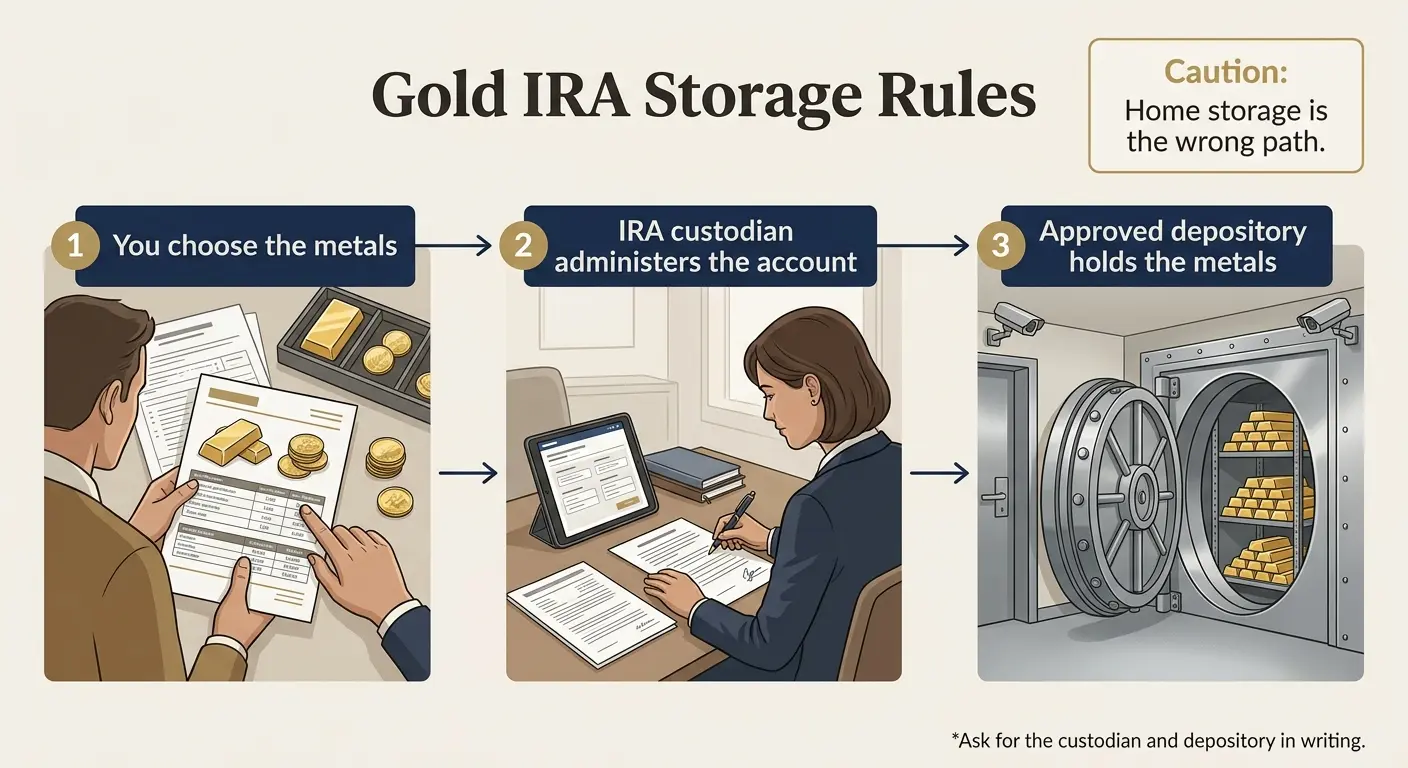
A self-directed IRA must be held by an IRS-approved custodian or trustee — a regulated trust company that administers the account, processes contributions and distributions, files the required tax forms, and holds title to the metals on behalf of the IRA. The custodian is not the same entity as the gold dealer; reputable providers maintain relationships with independent custodians like Equity Trust, STRATA Trust, Kingdom Trust, and GoldStar Trust.

The depository

The physical metals must be stored at an IRS-approved depository — a facility with the security, audit, and insurance standards required to hold IRA assets. Common depositories include Delaware Depository, Brink’s Global Services, IDS of Texas, HSBC, and JPMorgan. You do not take possession of the metals; the depository holds them on the custodian’s behalf for the benefit of your IRA.

Segregated vs. non-segregated storage

Most depositories offer two storage models. In non-segregated (commingled) storage, your metals are pooled with other clients’ metals of the same product type — when you withdraw or sell, you receive metals of equivalent type and quality but not the specific bars or coins originally purchased. Segregated storage holds the specific bars or coins you bought in a separately marked location and is usually more expensive. Either is acceptable; the choice depends on preference and budget.

Rollovers and transfers

Funding a gold IRA usually involves either a direct trustee-to-trustee transfer from an existing IRA or a rollover from an eligible employer plan such as a 401(k) or 403(b). A direct rollover does not trigger taxes or the early-withdrawal penalty, provided you do not take constructive receipt of the funds. Indirect rollovers — where the distribution check is made out to you — carry a strict 60-day deadline and 20% mandatory withholding; missing the deadline can produce taxes and penalties4.

Approved metals

The IRS requires specific purity standards: gold at 99.5% minimum (American Gold Eagle coins are a statutory exception at 91.67%), silver at 99.9% minimum, and platinum and palladium at 99.95% minimum4. Numismatic, proof, and collectible coins are typically excluded — but you will still encounter providers attempting to sell them inside an IRA at substantial markups. Always confirm a specific product with the custodian before purchasing.

The Companies

The 5 best gold IRA companies, reviewed

Each verdict below applies the published methodology. Cards are ranked in the editorial team’s order of overall preference for the typical reader of this report — a pre-retiree or retiree considering a small precious-metals allocation as part of a diversified portfolio.

Company A

OUR PICK

Editorial placeholder — a well-known full-service gold IRA provider.

How we evaluated this company

Documentation review · BBB complaint analysis · Public fee-schedule review

Company A is a placeholder for the provider our editorial team rated highest overall under the published criteria. In a finished review this paragraph would describe the company's history, target customer, how the rollover process works in practice, what their published fee schedule says (and where it differs from what salespeople quote on the phone), which IRS-approved custodians and depositories they pair with, how they handle segregated vs. non-segregated storage, what their BBB and Better Business Bureau Complaints record looks like over a multi-year window, and any open regulatory matters. The verdict would weigh transparency, IRS-compliance posture, and customer-service quality against pricing — and would explicitly note any pattern of high-pressure sales calls or fear-based pitches uncovered in customer interviews.

Pros

  • Published fee schedule is in writing before any account opening
  • Pairs with multiple IRS-approved depositories including segregated options
  • Educational materials accurately describe IRS rules on home storage
  • Documented multi-year BBB record with low complaint volume relative to size

Cons

  • Higher minimum investment than category average
  • Dealer markup on certain bullion products above industry norm
  • Online account dashboard is functional but dated
Minimum investment
$25,000
Setup fee
$50–$80 one-time
Annual custodian fee
$80–$100 / yr
Storage fee
$100–$150 / yr (non-segregated)
Transaction fees
Spread varies by product
Dealer markup over spot
Bullion: ~5–9% over spot
BBB rating
A+
Depositories
Delaware Depository, Brink's Global

Best for: Investors who want a well-documented, fee-transparent provider and are willing to meet a higher minimum.

Request Free Info Kit →

sponsored link · we may earn commission

Company B

BEST FOR LOW FEES

Editorial placeholder — positioned for fee-conscious bullion buyers.

How we evaluated this company

Documentation review · Fee-schedule cross-check · Sales-call transcript review

Company B is a placeholder for a provider that competes primarily on transparent, lower-than-average fees. In a finished review this paragraph would document the actual setup, custodian, storage, and transaction fees side-by-side with the industry-norm ranges; describe how the company achieves lower markups (for example, by limiting the catalog to a small set of approved bullion products rather than pushing numismatic or proof coins); and verify whether the published "flat fee for life" or "no fee for X years" promotions survive scrutiny over a multi-year holding window. The verdict would explicitly call out anything the company is sacrificing in service quality or product breadth in order to keep pricing low.

Pros

  • Lower-than-average annual custodian and storage fees
  • Narrow, bullion-focused catalog reduces high-markup upsells
  • Clear written fee schedule with annual escalator stated up front
  • Lower account minimum than category average

Cons

  • Smaller product catalog — limited platinum or palladium options
  • Customer service has weekday-only phone hours
  • Educational content is thinner than competitors
Minimum investment
$10,000
Setup fee
$0–$50 one-time
Annual custodian fee
$70–$90 / yr
Storage fee
$100 / yr
Transaction fees
Flat per-transaction fee
Dealer markup over spot
Bullion: ~3–6% over spot
BBB rating
A+
Depositories
Delaware Depository, IDS of Texas

Best for: Bullion-focused investors who want to keep recurring fees and product markups as low as possible.

Request Free Info Kit →

sponsored link · we may earn commission

Company C

BEST FOR LARGE ROLLOVERS

Editorial placeholder — built around larger rollover accounts.

How we evaluated this company

Documentation review · BBB complaint analysis · Custodian verification

Company C is a placeholder for a provider that explicitly positions itself for rollovers of $100,000 or more. In a finished review this paragraph would document whether the company waives setup or storage fees above a stated threshold, whether segregated storage is included or extra at higher balances, and how its dedicated account-management model performs in customer interviews. It would also examine the company's handling of in-kind distributions at retirement age — a meaningful operational difference at higher balances — and verify the custodian and depository relationships directly with each named partner.

Pros

  • Fee waivers triggered at higher balances reduce ongoing cost drag
  • Segregated storage available at larger account sizes
  • Dedicated account management with direct contact line
  • Cleaner published process for in-kind distribution at RMD age

Cons

  • High minimum investment makes the product inappropriate for smaller accounts
  • Fee structure becomes less competitive below the waiver threshold
  • Less inventory of fractional bullion products
Minimum investment
$50,000
Setup fee
Waived above $100K
Annual custodian fee
$125 / yr
Storage fee
$150 / yr (segregated avail. at $250K+)
Transaction fees
Spread varies by product
Dealer markup over spot
Bullion: ~4–7% over spot
BBB rating
A+
Depositories
Delaware Depository, Brink's Global, HSBC

Best for: Investors moving $100K+ from a prior 401(k) or IRA who want segregated storage and dedicated account management.

Request Free Info Kit →

sponsored link · we may earn commission

Company D

BEST FOR CUSTOMER EDUCATION

Editorial placeholder — strongest investor-education library.

How we evaluated this company

Documentation review · Educational-material accuracy check · IRS-rule audit

Company D is a placeholder for a provider whose primary differentiator is depth and accuracy of educational content. In a finished review this paragraph would audit the company's library against primary IRS guidance (Publication 590-A, Publication 590-B, and 26 U.S.C. § 408(m)) and note any place where marketing language softens, overstates, or contradicts the actual rule. It would specifically check whether the company correctly states that the IRS does not permit home storage of IRA precious metals, citing McNulty v. Commissioner, 157 T.C. No. 10 (2021). The verdict would weigh educational quality against fee competitiveness, which is often where education-led companies trade off.

Pros

  • Educational content cites primary IRS sources accurately
  • Explicitly rejects the home-storage gold IRA framing in its materials
  • Comparison tools surface real fee categories rather than headline rates
  • Strong onboarding for first-time precious metals investors

Cons

  • Annual fees somewhat higher than category average
  • Sales process can feel slow because of mandatory education steps
  • Smaller depository network than competitors
Minimum investment
$15,000
Setup fee
$80 one-time
Annual custodian fee
$100 / yr
Storage fee
$150 / yr
Transaction fees
Flat per-transaction fee
Dealer markup over spot
Bullion: ~5–8% over spot
BBB rating
A+
Depositories
Delaware Depository

Best for: First-time precious-metals investors who want to understand the IRS rules and fee structure before opening an account.

Request Free Info Kit →

sponsored link · we may earn commission

Company E

BEST FOR SMALLER ACCOUNTS

Editorial placeholder — lowest entry point for smaller IRA balances.

How we evaluated this company

Documentation review · Fee-schedule cross-check · Customer-service test

Company E is a placeholder for a provider that accepts smaller account minimums than category leaders. In a finished review this paragraph would document the actual minimum investment, the fee structure at small balances (where annual flat fees can become disproportionate as a percentage of assets), and whether the company will candidly tell a small-balance investor that a precious-metals IRA may not be cost-effective at that size. It would also assess the depository and custodian relationships available at the entry tier — sometimes smaller-account providers limit the higher-quality depositories to larger balances only.

Pros

  • Lowest account minimum among reviewed providers
  • Quick onboarding workflow
  • No-pressure sales calls reported in customer interviews
  • Transparent about when a precious-metals IRA is not a good fit

Cons

  • At very small balances, flat annual fees become a large percentage of assets
  • Limited depository options at the entry tier
  • Smaller catalog of approved bullion products
Minimum investment
$5,000
Setup fee
$50 one-time
Annual custodian fee
$80 / yr
Storage fee
$100 / yr
Transaction fees
Spread varies by product
Dealer markup over spot
Bullion: ~5–8% over spot
BBB rating
A
Depositories
Delaware Depository

Best for: Investors testing a small precious-metals allocation who want low minimums and no high-pressure sales.

Request Free Info Kit →

sponsored link · we may earn commission

At a Glance

Top gold IRA companies, compared

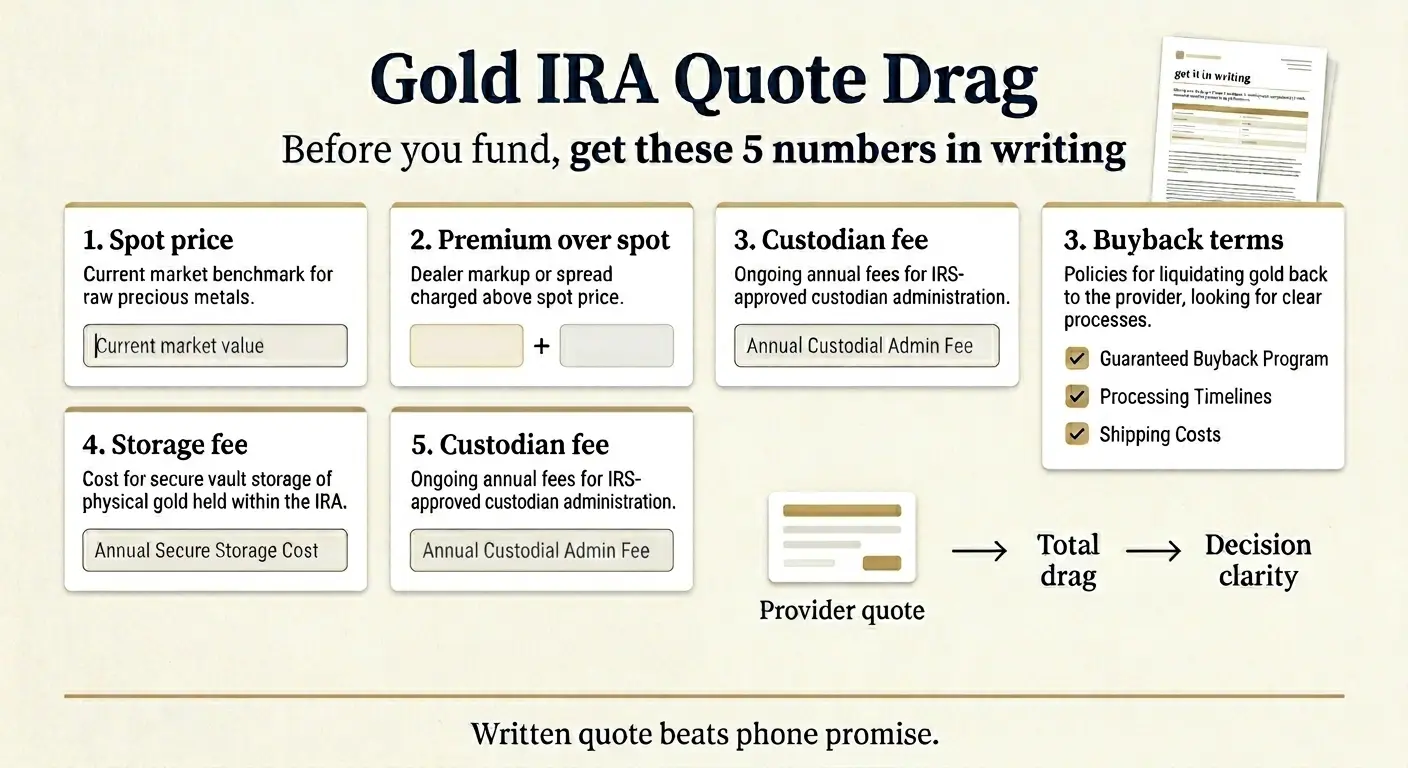
Pricing reflects published fee schedules and editorial cross-checks. Dealer markup over spot is the largest variable cost and is almost never on a published rate card; treat the ranges as directional and confirm in writing before opening any account.

CompanyMinimumSetup feeAnnual custodianStorage feeDepositoriesBBBBest for
Company A
OUR PICK
$25,000$50–$80 one-time$80–$100 / yr$100–$150 / yr (non-segregated)Delaware Depository, Brink's GlobalA+Investors who want a well-documented, fee-transparent provider and are willing to meet a higher minimum.
Company B
BEST FOR LOW FEES
$10,000$0–$50 one-time$70–$90 / yr$100 / yrDelaware Depository, IDS of TexasA+Bullion-focused investors who want to keep recurring fees and product markups as low as possible.
Company C
BEST FOR LARGE ROLLOVERS
$50,000Waived above $100K$125 / yr$150 / yr (segregated avail. at $250K+)Delaware Depository, Brink's Global, HSBCA+Investors moving $100K+ from a prior 401(k) or IRA who want segregated storage and dedicated account management.
Company D
BEST FOR CUSTOMER EDUCATION
$15,000$80 one-time$100 / yr$150 / yrDelaware DepositoryA+First-time precious-metals investors who want to understand the IRS rules and fee structure before opening an account.
Company E
BEST FOR SMALLER ACCOUNTS
$5,000$50 one-time$80 / yr$100 / yrDelaware DepositoryAInvestors testing a small precious-metals allocation who want low minimums and no high-pressure sales.

The Decision

How to choose the right gold IRA company for your situation

Start with your portfolio context

A precious-metals IRA should be one allocation in a diversified portfolio, not a replacement for one. Most fiduciary advisors describe an appropriate precious metals position as somewhere between 5% and 10% of overall retirement assets, depending on age, time horizon, and risk tolerance — though the right number for a given investor depends entirely on personal circumstances. The first step is not picking a company; it is talking with a fiduciary advisor about whether a precious metals position belongs in your plan at all.

Understand all the fees before you commit

Itemize every fee category — setup, annual custodian, annual storage (segregated or non-segregated), transaction fees, and, most importantly, dealer markup over spot price — and get them in writing before opening an account. Markup is the largest hidden cost and the one most providers are slowest to put on paper. A provider who will not commit to a written fee schedule should be eliminated from consideration on that fact alone.

Verify the custodian and depository directly

Reputable providers name their custodian and depository partners openly. Verify those relationships by contacting the named custodian and depository directly — both are regulated entities with public-facing customer service — and confirm that the dealer is in good standing with them. This is a five-minute call that has prevented investors from sending money to providers who never actually had the relationships they advertised.

Watch for the home-storage pitch

If a company suggests that you can take physical possession of IRA precious metals at home, in your own safe, or in an LLC you control, walk away. The IRS does not permit this, and the U.S. Tax Court has ruled against it2. The consequence of getting it wrong is reclassification of your entire IRA balance as a taxable distribution, with potential penalties — a downside vastly larger than any “control” upside the pitch claims.

Read complaints before you trust ratings

A BBB rating is a starting point, not an endorsement. Read the actual complaints filed against the company over the past three to five years and look for patterns — high-pressure sales, difficulty liquidating, surprise fees, or pushing inappropriate products. Check SEC litigation releases, state Attorney General actions, and Trustpilot trend lines. A company can have an A+ rating and still be the wrong choice for you.

The Rules

What the IRS actually allows in a gold IRA

The statutory framework for IRA precious-metals investing sits in 26 U.S.C. § 408(m)1. The general rule is that an IRA’s acquisition of a collectible is treated as a distribution to the IRA owner — and is therefore taxable. The statute then creates narrow exceptions: certain gold, silver, platinum, and palladium coins and bullion that meet specific fineness standards, provided they are held by an approved trustee or custodian.

Approved metals and purity standards

Gold must be 99.5% pure (the American Gold Eagle is a statutory exception at 91.67%). Silver must be 99.9% pure. Platinum and palladium must be 99.95% pure. The list of specifically eligible coins includes American Gold, Silver, Platinum, and Palladium Eagles9, Canadian Maple Leafs, Australian Kangaroo/Nuggets, Austrian Philharmonics, and approved bullion bars produced by COMEX- or LBMA-accredited refiners. Numismatic and proof coins are generally excluded from IRAs even if minted from approved metals — but some providers will still try to sell them at substantial markups.

The prohibition on collectibles

The collectibles prohibition is broad. Anything that does not meet the statutory carve-out — including rare or numismatic coins, jewelry, antiques, and most precious stones — produces a deemed distribution. The IRS Retirement Topics page on prohibited transactions outlines the related disqualified persons and prohibited transaction rules that can also produce a deemed distribution of the entire IRA balance10.

Custodian and storage requirements

The metals must be held by a trustee or custodian that meets the requirements of IRC § 408(a) — typically a bank, federally insured credit union, or state-chartered trust company. Physical possession by the IRA owner triggers a taxable distribution2. This is why the “home storage gold IRA” framing is structurally incompatible with the statute.

Red Flags

Gold IRA scams and red flags to avoid

Excessive dealer markup over spot

Some providers push numismatic, proof, or “exclusive” coins at 30% to 60%+ markup over spot price. Bullion at 3–10% markup is the industry norm; anything significantly above that should be treated as a red flag, not a feature. If a company cannot or will not benchmark its markup against the LBMA fix or COMEX spot, that is itself a signal.

High-pressure sales and urgency manufacturing

“Prices are about to spike,” “limited supply,” and “you need to decide today” are sales scripts, not investment advice. The SEC and FINRA have published investor alerts on exactly this pattern in the precious-metals retail space67. A reputable provider expects you to sleep on a five- or six-figure decision.

Fear-based selling

Predictions of imminent dollar collapse, hyperinflation, or stock-market crash are designed to push fast decisions, not inform them. Any company whose marketing relies on doomsday imagery rather than facts about its product is selling fear, not metal.

“Free silver” promotions

“Free metal” offers typically involve markups elsewhere — on a numismatic bundle, for example — that more than offset the “free” portion. Treat them as a prompt to scrutinize the full transaction, not as a discount.

Unclear or evasive fee disclosure

Any company that will not put its fee schedule in writing before account opening should be disqualified on that basis. No exceptions.

Tax & Fees

Gold IRA taxes, RMDs, and fees explained

Traditional vs. Roth

A Traditional gold IRA is funded with pre-tax dollars (where the contribution is deductible) and is tax-deferred: growth is not taxed until distribution, at which point distributions are taxed as ordinary income. A Roth gold IRA is funded with after-tax dollars; qualified distributions are tax-free. There is no such thing as a “tax-free gold IRA” as a standalone category; the tax treatment is determined by the underlying account type5.

Contribution limits

Contribution limits to a precious-metals IRA are the same as for any other IRA — the standard annual limit, plus the age-50+ catch-up. Current limits are published by the IRS each year11.

Required minimum distributions

Traditional IRAs, including precious-metals IRAs, are subject to required minimum distributions. The SECURE 2.0 Act of 2022 raised the RMD beginning age to 73, with a further increase to 75 in 20333. Account owners can take RMDs in cash (after the custodian sells metals at the prevailing market price) or in-kind by taking physical delivery of metals valued at fair market value on the distribution date. Roth IRAs are generally not subject to RMDs during the original owner’s lifetime.

Early withdrawal

Distributions before age 59½ are generally subject to the 10% additional tax on early distributions, with limited statutory exceptions5.

The fee categories

  • Setup fee. One-time, typically $50–$100.
  • Annual custodian fee. $80–$150, usually billed annually.
  • Annual storage fee. Often $100–$200 for non-segregated storage; segregated storage runs higher.
  • Transaction fees. Some custodians charge per-buy or per-sell flat fees.
  • Dealer markup over spot. The largest variable cost. Bullion commonly 3–10% over spot; numismatic and proof coins frequently 30%+.
  • Wire and shipping fees. Often small but worth disclosing in advance.

The Trade-Offs

Should you open a gold IRA? An honest look at the trade-offs

Past performance is not indicative of future results.

Reasons to consider one

  • Diversification: gold has historically had a different correlation pattern than equities, which can reduce overall portfolio volatility in certain regimes.
  • Physical-asset exposure that is not a counterparty claim on a corporation, government, or financial institution.
  • Some investors find a small precious-metals allocation behaviorally easier to hold through equity drawdowns.
  • Eligible for tax-advantaged treatment inside a Traditional or Roth IRA.
  • Can be transferred in-kind at distribution if you prefer physical metal at retirement.

Reasons to be cautious

  • Gold has historically underperformed broad equity indexes over long horizons.
  • Gold generates no yield — no dividends, no interest, no compounding from cash flow.
  • Ongoing storage and custodian fees create a small but persistent cost drag.
  • Dealer markup over spot is a real, often-hidden cost on both purchase and sale.
  • Liquidity at distribution depends on the custodian and depository’s in-kind delivery and sale processes.
  • Marketing claims about gold as a guaranteed inflation hedge are not supported by a consistent historical record.
  • Concentration in a single asset class is a risk in itself.

A precious-metals allocation may be a reasonable component of a diversified retirement portfolio for the right investor. It is not, by itself, the answer to retirement — and it is not appropriate for every investor.

Questions Answered

Frequently asked questions about gold IRAs

What is a gold IRA and how does it work?

A gold IRA — more precisely a self-directed precious metals IRA — is an individual retirement account that holds physical gold, silver, platinum, or palladium that meets IRS purity standards. The metals are held by an IRS-approved custodian and stored in an IRS-approved depository, not by the account owner. Contributions, tax treatment, and required minimum distributions otherwise follow the same Traditional or Roth IRA rules established under 26 U.S.C. § 408 and detailed in IRS Publications 590-A and 590-B.

Is a gold IRA a good investment for retirement?

It depends on your overall retirement picture and risk tolerance. A precious-metals allocation can offer diversification because gold's price has historically had a different correlation pattern than equities, but gold has also historically underperformed broad equity indexes over long horizons and generates no yield. Most fiduciary financial advisors describe precious metals as a small allocation within a diversified portfolio rather than a primary retirement vehicle. This article is informational and is not investment advice; consult a fiduciary advisor about your situation.

What are the IRS rules for gold IRAs?

Gold IRAs are governed primarily by 26 U.S.C. § 408(m), which generally treats investments in collectibles as taxable distributions but carves out specific exceptions for certain precious metal bullion and coins that meet defined purity standards and are held by an approved trustee or custodian. The metals must be held by an IRS-approved custodian, and they must be stored at an IRS-approved depository — not in your home, safe deposit box, or any LLC you control.

What gold and precious metals are IRS-approved for a gold IRA?

The IRS generally requires gold of at least 99.5% purity (American Gold Eagle coins are a statutory exception at 91.67%), silver of at least 99.9%, and platinum and palladium of at least 99.95%. Numismatic, proof, and collectible coins are typically excluded even if they are made from approved metals. Always verify a specific product with the custodian and against current IRS guidance before purchasing.

How much does it cost to open and maintain a gold IRA?

Costs typically include a one-time setup fee (often $50–$100), an annual custodian fee (often $80–$150), an annual storage fee charged by the depository (often $100–$200 for non-segregated and more for segregated storage), potential transaction fees, and — most importantly — a dealer markup over the spot price of the metal itself. Bullion markups commonly range from 3% to 10% over spot; numismatic and proof coins can carry markups of 30% or more and are usually inappropriate for an IRA.

Can I roll over my 401(k) into a gold IRA without penalties?

A direct trustee-to-trustee rollover from an eligible 401(k) into a Traditional self-directed IRA can generally be done without triggering taxes or the early-withdrawal penalty, provided you do not take constructive receipt of the funds. Indirect rollovers carry strict 60-day rules and 20% mandatory withholding, and missing the deadline can produce taxes and penalties. Coordinate with both plan administrators and a tax professional before initiating.

How do I roll over a traditional IRA into a gold IRA?

Open the self-directed IRA with a custodian that supports precious metals, request a direct transfer from your existing IRA custodian to the new one, then instruct the new custodian to purchase IRS-approved metals from your chosen dealer and deliver them to an approved depository. Keep all paperwork: the transfer should appear on Form 5498 from the receiving custodian and should not generate a taxable 1099-R.

Is a 'home storage gold IRA' legal?

No. Despite aggressive marketing of so-called 'home storage gold IRAs' and checkbook-LLC arrangements, the IRS does not permit the IRA owner to take physical possession of IRA precious metals. In McNulty v. Commissioner, 157 T.C. No. 10 (2021), the U.S. Tax Court held that an IRA owner's possession of gold coins through an LLC she owned constituted a taxable distribution. Any company promoting home storage of IRA metals is misrepresenting the rules.

What are the tax implications of a gold IRA?

A Traditional gold IRA is generally tax-deferred — contributions may be deductible and growth is not taxed until distribution, at which point distributions are taxed as ordinary income. A Roth gold IRA is funded with after-tax dollars and qualified distributions are tax-free. There is no such thing as a 'tax-free gold IRA' as a category; the tax treatment is determined by the underlying account type. Consult a tax professional about your specific situation.

What are required minimum distributions (RMDs) for a gold IRA?

Traditional IRAs, including precious metals IRAs, are subject to required minimum distributions. Under the SECURE 2.0 Act of 2022, the RMD beginning age was raised to 73, and it is scheduled to rise to 75 in 2033. Account owners can take RMDs either in cash (after the custodian sells metals at the prevailing market price) or in-kind by taking physical delivery of metals valued at fair market value on the distribution date. Roth IRAs are generally not subject to RMDs during the original owner's lifetime.

How do I avoid gold IRA scams and choose a reputable company?

Insist on a written fee schedule before opening an account. Verify the custodian and depository directly with each named institution rather than trusting marketing materials. Read multi-year BBB complaints and search for SEC and state Attorney General actions against the company by name. Walk away from any company that suggests home storage, manufactures urgency with 'limited supply' or 'prices about to spike' language, or pushes high-markup numismatic and proof coins. A reputable provider will tell you when a precious-metals IRA is not the right product for your situation.

What are the pros and cons of a gold IRA vs. a traditional IRA?

A traditional IRA invested in a diversified mix of equities and bonds has historically produced higher long-term real returns than physical gold, generates yield through dividends and interest, and carries no storage or custodian fees beyond ordinary brokerage costs. A gold IRA offers exposure to a physical asset with a different correlation pattern, but it generates no yield, carries ongoing storage and custodian costs, and is exposed to dealer markup at both purchase and sale. Most fiduciary advisors treat precious metals as a small diversification allocation rather than a substitute for a diversified portfolio.

The Bottom Line

Our bottom line on gold IRAs in 2026

For a pre-retiree or retiree considering a small precious-metals allocation, the editorial team’s overall preferred placeholder is Company A, on the basis of fee transparency, a documented IRS-compliance posture, and a multi-year complaint record that holds up to scrutiny. For fee-sensitive bullion-focused buyers, Company B is the placeholder of choice. For rollovers of $100,000 or more, Company C is structured for the category. For first-time precious-metals investors who want to understand the rules before committing, Company D leads on educational content. For investors testing a small allocation, Company E has the lowest minimum and a low-pressure sales process.

A gold IRA is not appropriate for: anyone without an adequate emergency fund and a stable income base; anyone whose retirement allocation is already heavily diversified into inflation-protected assets and who would simply be adding another correlated position; and anyone considering home storage. If a company has pitched home storage to you, that alone is a reason to walk away.

Before opening any account, talk with a fiduciary financial advisor and a tax professional about whether a precious-metals allocation belongs in your specific plan, at what size, and in what form (Traditional vs. Roth, segregated vs. non-segregated, and so on). Reread our affiliate disclosure: we may earn commissions on outbound links, but our rankings are determined against the published methodology before any commission discussion takes place.

About this report

How this report was produced

Authored collectively by The Retirement Index Editorial Team. Published May 18, 2026. Last reviewed May 18, 2026. For the full methodology, scoring rubric, fact-checking workflow, and corrections contact, see our editorial standards page. To submit a correction or flag a concern, write to corrections@theretirementindex.com.

Sources

Primary-source citations

  1. 1. 26 U.S. Code § 408(m) — Investment in collectibles treated as distributions. Legal Information Institute, Cornell Law School. law.cornell.edu
  2. 2. McNulty v. Commissioner, 157 T.C. No. 10 (2021) — United States Tax Court ruling that home storage of IRA precious metals through an LLC constitutes a taxable distribution. ustaxcourt.gov
  3. 3. SECURE 2.0 Act of 2022 — Required minimum distribution age changes. Internal Revenue Service guidance. irs.gov
  4. 4. IRS Publication 590-A — Contributions to Individual Retirement Arrangements (IRAs). irs.gov
  5. 5. IRS Publication 590-B — Distributions from Individual Retirement Arrangements (IRAs). irs.gov
  6. 6. U.S. Securities and Exchange Commission, Office of Investor Education and Advocacy — Investor Bulletin: Self-Directed IRAs and the Risk of Fraud. sec.gov
  7. 7. Financial Industry Regulatory Authority (FINRA) — Investor Alert: Gold Stocks and Self-Directed IRAs. finra.org
  8. 8. Consumer Financial Protection Bureau — Resources on retirement planning and avoiding investment fraud. consumerfinance.gov
  9. 9. U.S. Department of the Treasury — Information on U.S. Mint American Eagle bullion coins eligible for IRAs. usmint.gov
  10. 10. Internal Revenue Service — Retirement Topics: Prohibited Transactions. irs.gov
  11. 11. Internal Revenue Service — Retirement Topics: IRA Contribution Limits. irs.gov
  12. 12. U.S. Securities and Exchange Commission — Investor Alert: Fraudulent Stock Promotions Tied to Precious Metals. sec.gov

Stay current

Get the next Retirement Index report in your inbox

No promotions, no urgency, no list rentals. One email when a new pillar review is published or materially updated.